
About our logo
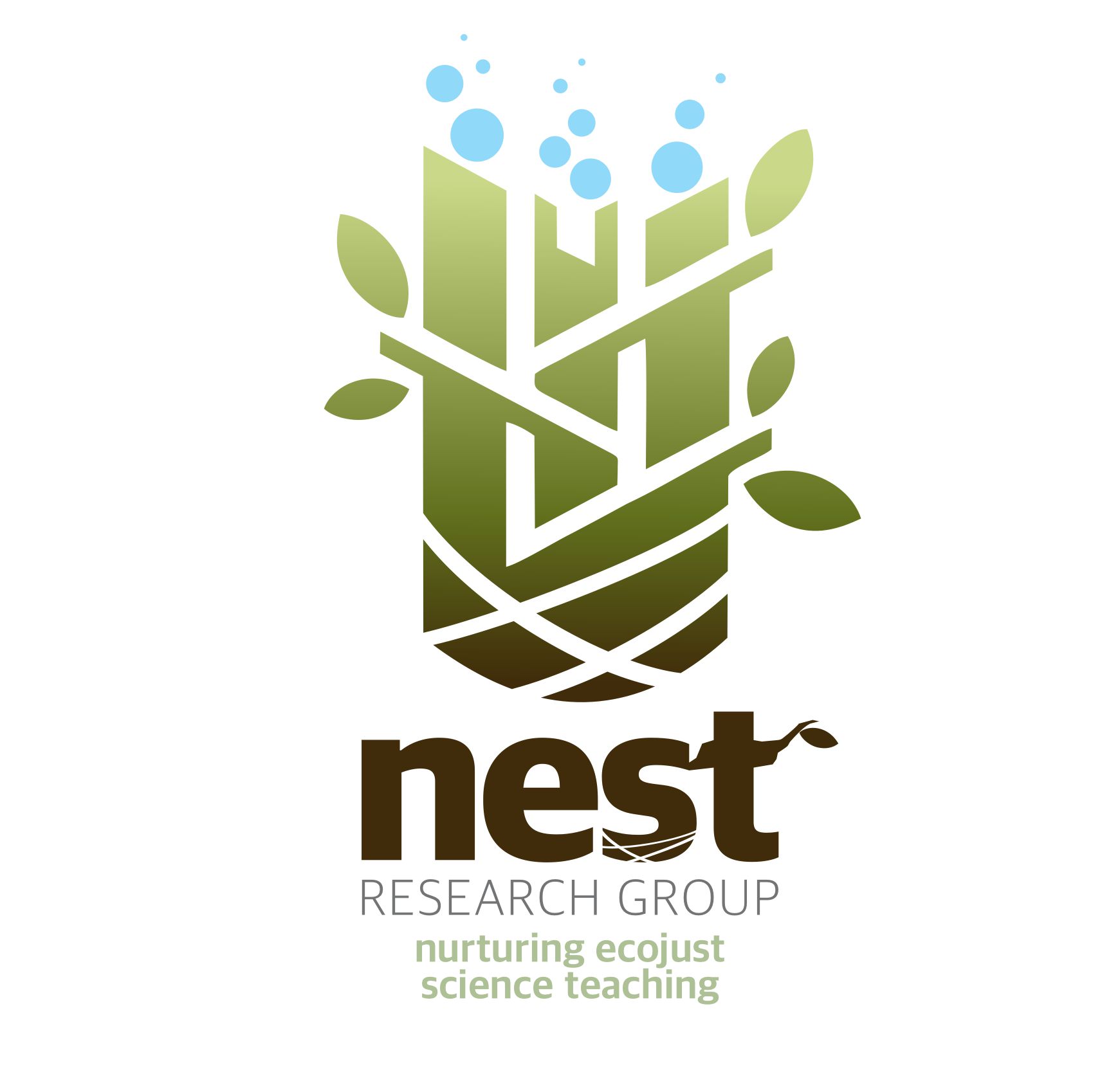
Our logo consists of a stylized rack holding three test tubes, reflecting our anchoring theme and background of most of us: the natural sciences. The rack extends downward into earthy tones, where several intertwining branches form a nest—echoing the name of our group. From this nest, additional branches rise, passing through the test tubes (breaking their glass) themselves and culminating in green leaves. It signifies our critical engagement with science: we believe science must change (or that we must change science) to foster a thriving coexistence for all Earth’s inhabitants. Finally, within one of the test tubes, a subtle human-like figure can be seen, integrated with the test tubes and the branches/leaves. This represents our commitment to bridging the human-nature divides.

Mission
The NEST group was born from the experience of its leader, Cristiano Barbosa de Moura, after many years of collaboration with the NIEHCC group in Brazil. Our aim was to create a collaborative space for research—a safe and nurturing environment where ideas could be shared, and perspectives exchanged. Like fledgling birds that eventually leave the nest to build new ones, we believe in supporting each member’s growth, fostering a cycle of renewal that contributes to rebuilding our world. What drives us is the pursuit of research that can transform both local and global realities, helping to repair the damaged world we inhabit. Our commitment to ecojustice reflects our desire to challenge hierarchical and oppressive/exploitative relationships—not only among humans, but also between humans and the more-than-human world. While not every project in our group is environmentally focused, we consistently reflect on how our work can contribute to a more wondrous and ecologically just world for all Earth’s inhabitants.
Our research focus
The research projects of our group are varied, but focus on promoting changes to science education that can improve students’ comprehension of science (and science education) as a historical, social and political endeavour. From that comprehension, we privilege (but are not limited to) the following topics:
- Cultural, historical, philosophical and sociological approaches to science in K-12 and teacher education settings.
- Cultural, historical, philosophical and sociological investigations of science education as a field of research.
- Justice-centred and decolonial approaches in science education for K-12 and teacher education settings.

NEST Team

Cristiano Barbosa de Moura, PhD
Researcher & Group Leader, SFU
Cristiano’s research examines and advances the sociopolitical turn in science education—the movement to reconceptualize science teaching with justice at its core. He explores this through HPSS-focused investigations of K-12 science teaching and teacher education, applying these same critical lenses to science education as a field of research itself.

Rodrigo Barcelos Lefebvre, MSc
PhD Student & Research Assistant, SFU
Rodrigo’s research examines and advances a cosmopolitical reorientation in science education—an effort to reconceptualize science teaching, curriculum, and policy as sites where ways of knowing, being, and relating are negotiated in the Anthropocene. He is particularly interested in how curriculum shapes forms of subjectivity and planetary belonging.

…
Test
…
Test
Visiting Researchers

Darlitt Meza Opazo, PhD Candidate
PhD Student, Universidad Catolica del Maule, Chile
Darlitt’s research examines the sociopolitical and epistemic configurations shaping physics education, with a particular focus on neoliberal rationalities and colonial matrices of knowledge. Her work engages decolonial and intersectional feminist perspectives to interrogate how objectivity, neutrality, and universality are constructed in science education. She explores how physics operates as a contested terrain where justice, subjectivity, and epistemic hierarchies are negotiated.

Penha Souza Silva, PhD
Visiting Researcher at SFU, Associate Professor at the Universidade Federal de Minas Gerais, Brazil
Penha’s research explores the sociopolitical dimensions of rural science teacher education in Brazil. Drawing from critical pedagogies and investigating the formative trajectories of pre-service teachers in the LeCampo program at the Universidade Federal de Minas Gerais, she seeks to understand how those trajectories reflect a commitment to the principles of social justice, understood from multiple angles (e.g. environmental, cognitive, etc.).
Collaborators
Jane Doe
Test

John Doe
Test
Past members
Jane Doe
Test
John Doe
Test
John Doe
Test
 NEST Research Group